MAJOR ARCANA · 13
Death tarot card meaning
The quick meaning
The Death card symbolizes an ending, transition and the reorganization that follows. It is not a prediction of physical death. Read it as a prompt to examine what has run its course and what becomes possible when a chapter changes.
Swipe the table to compare all columns →
| Upright | Reversed |
|---|---|
| Endings, Transition, Renewal | Resistance, Stagnation, Unfinished endings |
What to notice in the image
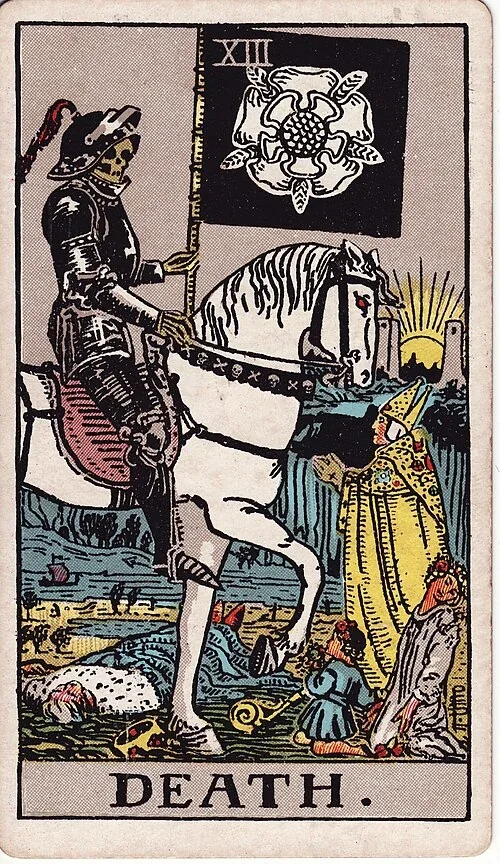
The armored rider
A skeleton rides through a scene containing people in different positions. The image suggests that change does not apply only to one kind of person or status.
The white rose on the banner
The flower appears within a stark scene. In this guide, it supports reflection on the continuity and renewal that can accompany an ending.
The sun between two towers
Light appears on the horizon, giving the composition a direction beyond its immediate disruption. An ending is part of a changing sequence.
Death upright
Upright, Death can invite an honest acknowledgment that a habit, role or arrangement no longer serves its earlier purpose. Continuing automatically may use energy that a new pattern needs. The response does not have to be dramatic: finishing a commitment, changing a routine or naming a changed expectation can all be meaningful transitions. There can be grief and relief at the same time.
Death reversed
Reversed, the card may draw attention to resistance, an unfinished ending or change happening privately and gradually. Ask what makes release difficult. Is there a real responsibility to complete, an emotion that needs time, or a familiar identity that feels hard to set down? Allow a specific answer rather than treating every delay as failure. A transition can be slow and still move.
Love and relationships
Reflect on a pattern or expectation that may need to change. This does not mean a relationship must end. A direct conversation can clarify whether the transition concerns a habit, a boundary, a shared plan or the relationship itself.
Work and projects
An old workflow or role may need review. Document what remains useful, complete necessary handoffs and identify what would make a new arrangement sustainable. Do not use a card alone as a reason to leave a job or abandon a commitment.
Money habits
The useful reflection is about outdated habits or assumptions. Review the actual facts before changing a financial arrangement. Symbolic renewal is not evidence of a coming loss or an instruction to make a transaction.
A spread example
In a five-card spread, Death in the Challenge position could prompt you to ask which ending you have not fully acknowledged. In Support, it might suggest that removing an outdated obligation creates needed space. In Action, it can inspire one deliberate closure step rather than a sweeping decision.
Try a reflection exercise
A weekly activity once felt meaningful but now continues mainly from habit. What is one careful way to reflect with Death?
One possible answer
Identify what the activity originally provided, whether it still provides it and who would be affected by a change. You might adjust the commitment, conclude it thoughtfully or renew it for a clear reason. The card does not choose for you.
Similar cards: what changes in the question?
Death centers on an ending and transition. The Tower emphasizes disruption that exposes an unstable structure. The World emphasizes completion and integration. These themes can overlap, but they ask different questions.
Swipe the table to compare all columns →
| Card | Emphasis in our approach | Useful question |
|---|---|---|
| Death | An ending and the transition around it | What has finished its purpose? |
| The Tower | Disruption of an unstable assumption | What has been exposed that I can no longer ignore? |
| The World | Completion and integration | What can I recognize as a whole before moving on? |
Consider a group project. Death might prompt the orderly closure of a role that is no longer needed. The Tower might prompt reflection after a mistaken assumption has abruptly become visible. The World might invite recognition of the completed project and the skills gained. All three can involve change, but the kind of attention each asks for differs.
What exactly is ending?
Suppose a weekly creative group has become difficult to attend. “Death means I must leave” skips several possibilities. The thing that has ended might be the old meeting time’s usefulness, your availability for a volunteer role, or the expectation that every meeting must include everyone. Name the pattern before deciding what response would be considerate.
Read the same situation with a reversal
Reversed, ask why the transition feels incomplete. Perhaps you need to tell the organizer, return shared materials or acknowledge that you will miss the routine. Completing those steps differs from forcing yourself to feel ready immediately. Resistance can contain information about obligations or feelings; it is not automatically a personal failure.
For a repeatable method, see upright vs reversed cards. Select the interpretive lens before looking for a reassuring conclusion.
Death with The Fool: closing one part, starting another
As an illustrative pairing, Death in Challenge and The Fool in Action could suggest that a new experiment is easier once an old commitment has been addressed. The practical connection might be finishing a handoff before trying a different schedule. This is not a universal combination meaning: without the positions and the situation, the pairing remains broad.
Compare the roles in our one-, three- and five-card spread guide, including fixed examples you can open in the tool.
A journal exercise you can revisit
- The pattern that may have finished its purpose is…
- The responsibility I still need to complete is…
- One part I would like to carry into the next phase is…
Return to the note after one closure step. Did anything become clearer? What remains unresolved? The exercise can make room for mixed feelings while still distinguishing a completed task from an expectation that takes longer to change.
Questions about Death
Does the Death card predict someone’s death?
No. This guide uses Death as a symbol of endings and transition, not a way to determine whether a person will die.
Is Death a bad card?
An ending can be difficult, relieving or both. The card’s name does not establish whether a situation is good or bad for you.
Does it mean my relationship will end?
No. It can invite reflection on a changing pattern or expectation. The state of a relationship needs communication and real-world evidence.
What does Death reversed mean?
It can point toward resistance, slow change or an ending that feels incomplete. Start by identifying what is actually difficult to release.
Should I make a major change because I drew it?
Do not let a card make the decision. Use the reflection to identify a question, then consider your circumstances and relevant practical advice.
How is it different from The Tower?
Death emphasizes transition and the ending of a cycle. The Tower emphasizes a disruption that reveals instability or an assumption that no longer holds.
What is a gentle journal prompt for Death?
Try: “One thing that has finished its purpose is…” Then ask what a considerate, manageable next step would be.
Can I skip this card when practicing?
You can choose not to focus on an image that feels uncomfortable. This tool draws from the full deck; you can close the result or start a new reading.
Sources and interpretation
Original reflection-focused explanation published under the editorial pen name Rowan Vale. Historical symbolism can be compared with A. E. Waite’s The Pictorial Key to the Tarot. Our prompts are an interpretive approach, not direct quotations or a claim to one universally correct reading.
Artwork: Pamela Colman Smith, historical 1910 Pam-A deck scan. View this card’s source and public-domain record. Read the editorial method or suggest a correction.
