MAJOR ARCANA · 0
The Fool tarot card meaning
The quick meaning
The Fool represents a beginning, openness and the willingness to explore without knowing everything in advance. Its useful tension is between trust and attention: curiosity matters, and so does noticing where you are about to step.
Swipe the table to compare all columns →
| Upright | Reversed |
|---|---|
| Beginnings, Curiosity, Trust | Carelessness, Hesitation, Preparation |
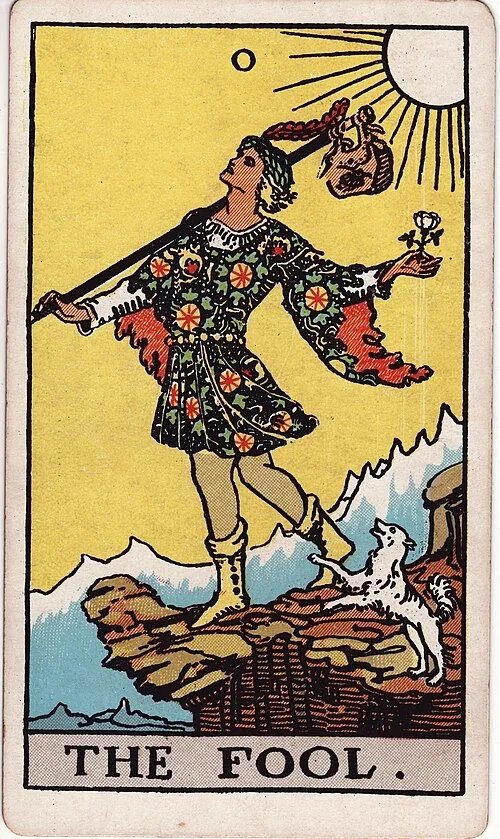
What to notice in the image
The cliff edge
The figure is close to an edge while looking upward. This can prompt a conversation between possibility and practical awareness.
The small bundle
The light luggage suggests beginning with limited baggage. It can invite you to consider what is genuinely needed for the next step.
The dog and white rose
The dog adds alertness to the scene, while the rose offers a gentler note. Openness does not need to exclude a useful warning.
The Fool upright
Upright, The Fool can invite a first experiment: attending a class, starting a conversation or trying a small version of an idea. It does not ask you to abandon judgment. Instead, consider whether the need for complete certainty is preventing any learning at all. A well-chosen beginning leaves room to discover more as you go, without requiring a large irreversible commitment.
The Fool reversed
Reversed, The Fool can describe hesitation, carelessness or an uneasy relationship with uncertainty. Those possibilities are different, so context matters. If you keep postponing a manageable action, the prompt may be to reduce its scale. If you are ignoring an obvious requirement, the prompt may be to prepare. The card does not decide which situation you are in; your own facts do.
Love and relationships
A new connection can be approached with curiosity while respecting boundaries. For an established relationship, the prompt may concern trying something unfamiliar together. Neither trust nor a sense of possibility removes the need for consent and direct communication.
Work and projects
Treat an unfamiliar task as a learning process. Define a small first deliverable and find out what support is available. Enthusiasm can make it easier to begin, but it is not a substitute for understanding the obligations of a new role.
Money habits
Reflect on how novelty affects your choices. An appealing new idea may deserve research before resources are committed. The Fool is a prompt to examine your relationship with uncertainty, not an instruction to take a financial risk.
Bring it back to your own reading
What would a small, well-considered beginning look like?
Draw a tarot cardA spread example
With The Fool in the Past position, you might reflect on a recent beginning and what you did not know then. In the Present position, it might prompt a modest experiment. In Possible direction, it offers a way to approach the next stage with curiosity rather than a promise that a particular opportunity will arrive.
Try a reflection exercise
You want to try a new creative hobby but believe you need expensive equipment first. What would a grounded Fool response look like?
One possible answer
Try one session with borrowed or basic materials, then note what you learned and whether the interest remains. This turns curiosity into an experiment while avoiding a large commitment before you have information.
Similar cards: what changes in the question?
The Magician focuses on deliberately using available tools and skills. The Fool focuses on the openness of beginning. One asks how to act with intention; the other asks what becomes possible when you allow yourself to start.
Swipe the table to compare all columns →
| Card | Emphasis in our approach | Useful question |
|---|---|---|
| The Fool | Entering unfamiliar territory | What can I learn through a first attempt? |
| The Magician | Using available resources deliberately | How can I turn what I have into a concrete action? |
| The World | Completing and integrating a cycle | What has come together, and what should I carry forward? |
For a new drawing hobby, The Fool might invite a first class, The Magician might focus on using the pencil and paper already on your desk, and The World might prompt a review of what a completed course taught you. These themes can appear at different scales. You can finish one exercise while still being a beginner in the larger subject.
A beginning is different from an unchecked leap
Imagine being invited to help with a community exhibition. You are interested but have never displayed your work. The Fool can prompt a small first step: ask about the format and offer one piece. That preserves curiosity while letting you discover the practical requirements. A dramatic commitment is not necessary for the beginning to be meaningful.
Read the same situation with a reversal
Reversed, the same scenario asks for a closer look at the hesitation. If the date and transport arrangements are unknown, checking them is sensible preparation. If those details are settled and you are waiting to feel completely confident, a modest commitment may be the experiment you need. The card alone cannot distinguish preparation from avoidance.
For a repeatable method, see upright vs reversed cards. Select the interpretive lens before looking for a reassuring conclusion.
The Fool with The Sun: starting and learning
In the linked three-card teaching example, The Fool is in Past and The Sun in Present. One possible connection is that a small beginning made something clearer through experience. The useful question is what you learned, not whether you were destined to succeed. If the positions were reversed, you could instead consider whether present clarity makes a fresh experiment easier.
Compare the roles in our one-, three- and five-card spread guide, including fixed examples you can open in the tool.
A journal exercise you can revisit
- The unfamiliar step I am considering is…
- One fact I need before trying it is…
- The smallest version that would teach me something is…
After the experiment, compare what you expected with what actually happened. Record one surprise and one practical lesson. This turns “beginner’s openness” into a learning process rather than an excuse to ignore the outcome.
Questions about The Fool
Why is The Fool numbered zero?
In this Rider–Waite–Smith deck, zero places The Fool outside the numbered progression from I to XXI. It fits the idea of potential before a path is fully defined.
Does The Fool mean I should take a leap?
Use it to consider a beginning, not as an instruction to take an unchecked risk. A small reversible experiment is often a useful way to explore its theme.
Is the reversed Fool always reckless?
No. Reversal may also describe hesitation or a need to prepare. Decide which interpretation fits the observable situation.
Can The Fool mean a new relationship?
A new connection is one possible context for the theme of beginning, but the card does not establish that a relationship will occur.
What does The Fool mean for a beginner?
It can make being new feel legitimate. You are allowed to learn through a manageable first attempt rather than proving expertise before starting.
What is the dog doing in the image?
The small dog is beside the figure near the cliff. As a reflection prompt, it can represent alertness or the value of paying attention to the immediate environment.
How can I journal with this card?
Write down one small thing you are curious about, the simplest way to try it and one practical consideration you should not ignore.
How does The Fool differ from The Magician?
The Fool emphasizes entering unfamiliar territory; The Magician emphasizes focusing existing resources into action.
Sources and interpretation
Original reflection-focused explanation published under the editorial pen name Rowan Vale. Historical symbolism can be compared with A. E. Waite’s The Pictorial Key to the Tarot. Our prompts are an interpretive approach, not direct quotations or a claim to one universally correct reading.
Artwork: Pamela Colman Smith, historical 1910 Pam-A deck scan. View this card’s source and public-domain record. Read the editorial method or suggest a correction.
